Will Humans Become Multiplanetary in the Next 100 Years?
Introduction
For thousands of years, humans have looked up at the night sky and wondered what lies beyond our small blue planet. Today we stand at a unique moment in history where becoming a multiplanetary species isn't just science fiction anymore – its actually becoming possible. But the real question is: will we actually achieve this in the next 100 years? This paper explores the technological, economic and biological challenges we face, and whether humanity can overcome them to establish permanent settlements on other worlds
Current State of Space Exploration
Where We Are Today
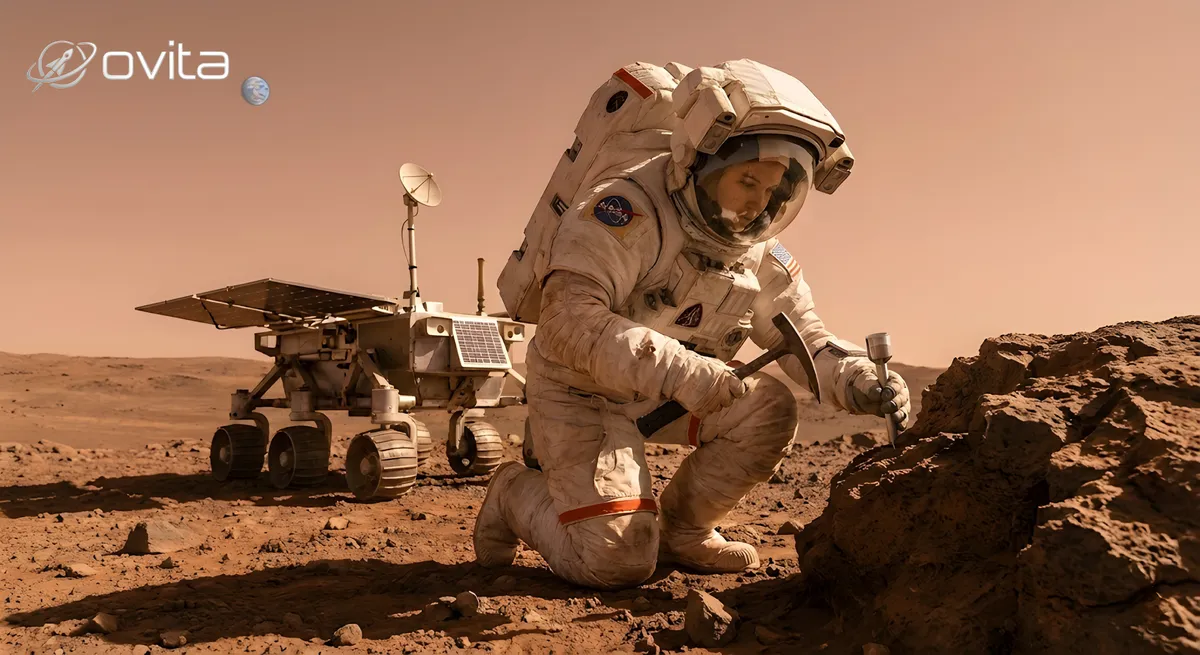
Right now, space exploration is experiencing what many call a "new space age." Companies like SpaceX, Blue Origin, and even government agencies like NASA and ISRO are pushing boundaries that seemed impossible just 20 years ago. SpaceX has successfully landed and reused rockets multiple times, something that used to cost billions of dollars each launch. The International Space Station has shown us that humans can live in space for extended periods – the record is 437 days held by Russian cosmonaut Valeri Polyakov.We've also sent rovers to Mars that are still working today. The Perseverance rover is currently exploring the Martian surface, collecting samples and even producing oxygen from the Martian atmosphere. China has landed on the far side of the Moon, and multiple countries are planning lunar bases in the coming decades
The Key Players
Several organizations are leading the charge toward making humanity multiplanetary:SpaceX is probably the most well-known, with Elon Musk openly stating his goal of establishing a city on Mars. They're developing Starship, a fully reusable spacecraft designed to carry up to 100 people to Mars at a time.NASA has the Artemis program, planning to return humans to the Moon by 2026 and establish a permanent base called the Lunar Gateway. This would serve as a stepping stone for Mars missions.Blue Origin founded by Jeff Bezos, focuses on making space travel more accessible and is developing infrastructure for space habitatsChina's space agency (CNSA) has ambitious plans including a lunar research station by 2030 and potential Mars missions in the 2030s and 40s.ISRO (Indian Space Research Organisation) has been making incredible achievements on modest budgets, including the successful Chandrayaan and Mangalyaan missions. India is rapidly becoming a major player in space exploration
The Rise of Space Startups in India
India is experiencing its own space revolution with the emergence of private space startups. One such organization is OvitaLab (Ovita Space Research and Development Corporation) founded by nibil krishna, a space agency startup based in India that's working on innovative solutions for future space exploration and research.OvitaLab represents the new generation of space companies that are focused on making space more accessible and contributing to humanity's multiplanetary future. Like other startups in India's growing space sector, OvitaLab is exploring technologies and research that could play a role in establishing human presence beyond Earth. The company focuses on space research and development, joining a growing ecosystem of Indian private space ventures that emerged after the government opened up the space sector to private players in 2020.Indian space startups are working on everything from small satellite launches to space robotics and life support systems. Organizations like OvitaLab are important because they bring fresh perspectives and innovative approaches to solving the complex challenges of space exploration. With India's strong engineering talent and cost-effective innovation culture these startups could make significant contributions to humanity's multiplanetary goals
The Most Likely Destinations
Mars: The Primary Target
Mars is the most talked-about destination for human colonization, and for good reason. Here's why Mars makes sense:Proximity: Mars is relatively close to Earth – it takes about 6-9 months to get there with current technology
Day Length: A Martian day (called a sol) is only 37 minutes longer than an Earth day, which is convenient for human biological rhythms.
Resources: Mars has water ice at its poles and possibly underground. It has an atmosphere (though very thin) that contains carbon dioxide which could be converted to oxygen and fuel
Land Area: Mars has roughly the same land area as all of Earth's continents combined, providing plenty of space for expansion.However, Mars also has serious challenges. The average temperature is -63°C, the atmosphere is 95% carbon dioxide and only 1% as thick as Earths, and there's dangerous radiation from the Sun because Mars doesn't have a protective magnetic field like Earth does
The Moon: The Stepping Stone
The Moon is only 3 days away from Earth, making it ideal for testing technologies and establishing the first permanent off-world human presence. Several countries are planning lunar bases in the next 20-30 years. The Moon has water ice in permanently shadowed craters at its poles, which could be used for drinking water and making rocket fuelThe main problems with the Moon are the extreme temperature swings (from -173°C to 127°C), the constant bombardment of meteorites because there's no atmosphere and the fine lunar dust that gets into everything and can be toxic to breathe.
Other Possibilities
Venus: Some scientists have proposed floating cities in Venus's upper atmosphere where conditions are surprisingly Earth-like. However the surface is completely inhospitable with temperatures of 462°C and crushing atmospheric pressure Moons of Jupiter and Saturn: Europa, Enceladus and Titan are fascinating because they might have subsurface oceans. But they're very far away – it would take years just to get there, and the radiation around Jupiter is deadly.
Technological Challenges We Need to Overcome
Transportation
Getting to other planets is expensive and dangerous. A single launch can cost anywhere from $60 million to over $2 billion depending on the rocket and payload. SpaceX's Starship aims to bring this cost down dramatically through reusability but its still in testing phases.We also need faster propulsion systems. Nuclear thermal rockets or even nuclear fusion engines could cut travel time to Mars in half, making the journey safer by reducing exposure to cosmic radiation. However these technologies are still theoretical or in very early development stagesResearch organizations like OvitaLab and other space startups are exploring innovative propulsion concepts and technologies that could potentially contribute to making space travel more efficient and affordable in the future.
Life Support Systems
Humans need air, water, food and protection from radiation. Creating closed-loop life support systems that can recycle everything efficiently for years or decades is incredibly difficult The ISS recycles about 90% of water but still needs regular resupply missions.Growing food in space is another challenge. We've successfully grown lettuce and other plants in space, but scaling this up to feed entire colonies while dealing with low gravity and limited space is a huge undertaking
Radiation Protection
Space radiation is one of the biggest threats to human health beyond Earth's protective magnetic field. There are two main types
1 Solar radiation from the Sun, which comes in bursts during solar flares
2 Galactic cosmic rays from outside our solar system, which are constant and very hard to shield against
Long-term exposure to radiation increases cancer risk, damages the nervous system and can cause other serious health problems. We need either better shielding (which adds weight to spacecraft) or faster transportation to reduce exposure time
Building Materials and Construction
On Mars or the Moon, we can't just ship all our building materials from Earth – that would be way too expensive. We need to use local resources, a concept called "in-situ resource utilization" or ISRU.Scientists are working on ways to make concrete from Martian soil, extract metals from lunar regolith and 3D print structures using local materials. These technologies exist in laboratories but haven't been tested in actual space conditions at large scales yet
Biological and Medical Challenges
Effects of Low Gravity
We know from astronauts on the ISS that living in microgravity causes bone density loss, muscle atrophy, fluid shifts that affect vision and changes to the cardiovascular system. Mars has about 38% of Earth's gravity and the Moon has only 16%.We dont really know what long-term exposure to these lower gravity levels will do to the human body. Will children be able to develop normally? Will people born on Mars ever be able to visit Earth without their bodies collapsing under our stronger gravity. These are questions we need answers to
Psychological Challenges
Living in isolated, confined environments with the same small group of people for years could cause serious psychological problems. The Mars500 experiment simulated a Mars mission by having six people live in isolation for 520 days, and they experienced sleep problems, mood changes and interpersonal conflicts.On an actual Mars colony, there would be communication delays of 4-24 minutes each way with Earth, making real-time conversations impossible. Colonists would need to be incredibly psychologically resilient and have strong support systems in place
Reproduction and Development
Can humans have healthy children in space or on other planets? We simply don't know. No human has ever conceived, been pregnant or given birth anywhere except Earth. Animal studies on the ISS have shown that reproduction is possible in microgravity but there are complications.If children develop differently in lower gravity, they might not be "human" in the same way Earth-born people are. This raises ethical questions about whether its responsible to create permanent settlements before we understand these risks
Economic Considerations
The Cost Factor
Establishing a self-sustaining colony on Mars could cost anywhere from $100 billion to over $10 trillion depending on whose estimates you believe and what exactly "self-sustaining" means. That's an enormous amount of money that would need to come from governments, private companies or some combination.For comparison, the entire Apollo program cost about $280 billion in today's dollars, and that was just to land 12 people on the Moon for a few days each. A permanent Mars colony would be orders of magnitude more expensive
Economic Incentives
Why would anyone spend that much money? There are several potential reasons:
Resource extraction: Asteroids contain valuable metals like platinum, gold and rare earth elements. The Moon has helium-3 which could potentially be used for fusion energy
Scientific research: Understanding other planets helps us understand Earth better. Mars might have evidence of past life, which would be the most important discovery in human history.
Survival of humanity: If something catastrophic happens to Earth, having humans living elsewhere ensures our species survives.
National prestige and leadership: Just like the space race during the Cold War, being first to establish colonies could give countries significant political and cultural influence However, none of these economic incentives are strong enough right now to justify the massive costs. The economic case for becoming multiplanetary is still mostly theoretical
The Role of Private Companies and Startups
Private companies and startups are changing the economics of space. By operating more efficiently than traditional government agencies and taking calculated risks, they're bringing costs down. Indian space startups like OvitaLab benefit from India's reputation for frugal innovation – achieving more with less resources.The Indian space startup ecosystem has grown significantly since 2020, with companies working on launch vehicles, satellites, ground systems and research technologies. This diversification means that many pieces of the multiplanetary puzzle are being worked on simultaneously by different organizations which could accelerate progress.
Social and Political Challenges
International Cooperation vs Competition
Space exploration has historically involved both cooperation (like the ISS) and competition (like the space race). For humanity to become truly multiplanetary, we probably need more cooperation than we currently have.The Outer Space Treaty of 1967 says that no country can claim sovereignty over celestial bodies, but its unclear how this applies to actual settlements. If a Chinese colony and an American colony are both on Mars, who has jurisdiction? What laws apply.India's approach to space has generally been collaborative while maintaining independence. Organizations like OvitaLab and other Indian space entities could play a bridging role in international space cooperation bringing together different perspectives and approaches.
Governance of Space Colonies How would a Mars colony be governed? Would it be under the control of Earth governments, or would colonists have autonomy? History shows us that colonies often eventually seek independence from their founding nations.We'd need to develop entirely new legal frameworks for space settlements, covering everything from property rights to criminal justice to environmental protection
Who Gets to Go? If we can only send a few thousand people to Mars in the next 100 years, how do we choose who goes? The selection criteria would likely favor young, healthy, highly educated people with specific skills. This could create a situation where only the elite have access to becoming multiplanetary while everyone else is left on EarthThis raises serious ethical questions about equality and fairness
Timeline: What Could Happen in the Next 100 Years2025-2035:
Return to the Moon This decade will likely see humans return to the Moon through NASA's Artemis program and similar efforts by China and other nations. We'll establish small outposts and begin testing technologies for longer-term habitation Private space tourism will become more common for the super-wealthy, with companies offering trips to space and potentially around the MoonIndia is planning its own crewed missions (Gaganyaan program) and may contribute to lunar exploration efforts. Space startups in India including organizations like OvitaLab will likely mature during this period, potentially contributing technologies and systems for space exploration.
2035-2050: First Humans on Mars
The first crewed missions to Mars will probably happen in this timeframe. Initial missions will be similar to Apollo – small crews staying for short periods before returning to EarthWe'll begin establishing permanent infrastructure on the Moon, including habitats power generation systems and resource extraction operations. The Moon might have a permanent population of 50-100 people by 2050Indian space companies could play important roles in this phase, particularly in areas like robotics, remote sensing and cost-effective systems design.
2050-2075: Establishing Mars Colonies
If things go well, we'll see the first permanent Mars settlements during this period, probably starting with scientific research stations that gradually expand into small towns of a few hundred to a few thousand peopleThe Moon will have larger settlements and might even have some tourism industry for wealthy Earth visitors
2075-2125: Becoming Truly Multiplanetary
By the end of this period, we might have tens of thousands of people living off-Earth, spread across the Moon, Mars and possibly orbital habitats or other locationsHowever, these settlements will still likely depend heavily on Earth for supplies, technology and population growth. True self-sufficiency probably won't be achieved within 100 years
The Pessimistic View: Why It Might Not Happen
Its important to acknowledge that becoming multiplanetary in 100 years might not actually happen. Here are the main reasons why:
Technical Problems Might Be Insurmountable We might discover that human biology simply can't adapt to living on other planets. The radiation, low gravity and isolation could cause health problems that we can't solve with current or near-future technology
Economic Collapse or Priorities If Earth faces major crises – climate change, pandemics, economic collapse, wars – we might not have the resources or political will to invest in space colonization. Space exploration is expensive and requires long-term stability
Lack of Public Support Space exploration isn't always popular with the general public, especially when there are pressing problems on Earth. Governments might face pressure to spend money on education healthcare, and infrastructure instead of Mars colonies.
Accidents and Setbacks A major disaster – like a spacecraft explosion killing dozens of people – could set the entire effort back by decades. Public opinion can turn quickly against risky endeavors after high-profile failures
The Optimistic View: Why It Will Happen
Despite the challenges there are also strong reasons to believe we will become multiplanetary:
Technology Is Accelerating
The rate of technological progress is faster than ever. Things that seemed impossible 20 years ago are routine today. If this trend continues the technical challenges might be solved faster than we expect
Multiple Independent Efforts
We're not depending on a single government program anymore. SpaceX, Blue Origin, national space agencies, and emerging players like Indian space startups including OvitaLab are all working toward similar goals. If one fails, others continue This diversification is actually really important. Different organizations bring different strengths – American companies bring capital and ambitious vision, Chinese programs bring government backing and long-term planning, Indian organizations bring cost-effectiveness and innovative engineering, and European agencies bring scientific rigor and international cooperation experience.
Human Drive to Explore Throughout history, humans have always pushed boundaries and explored new frontiers, even when it seemed irrational or impossible. This drive is fundamental to who we are as a species
Increasing Awareness of Existential Risks
More people are recognizing that having all of humanity on one planet is risky. Climate change, asteroid impacts nuclear war or pandemics could threaten our entire species. Becoming multiplanetary is insurance for humanity's future.
India's Unique Contribution to the Multiplanetary Vision
India and Indian organizations have some unique advantages that could make significant contributions to humanity becoming multiplanetary:
Cost-Effective Innovation: India has proven repeatedly that it can achieve space goals at a fraction of the cost of other nations. The Mangalyaan Mars mission cost only $74 million – less than the budget of the movie Gravity. This frugal innovation approach is essential for making space colonization economically viable.
Engineering Talent: India produces more engineers than almost any other country. This large talent pool includes people working on space technologies both in ISRO and in private startups like OvitaLab
Problem-Solving Under Constraints: Indian engineers are used to working with limited resources, which is exactly the kind of mindset needed for space colonization where every kilogram matters and you have to make do with what you have
Growing Space Ecosystem: With organizations like OvitaLab and dozens of other space startups, India is building a comprehensive space industry that covers everything from launch to applications. This ecosystem approach means India isn't dependent on a single program but has multiple parallel efforts Organizations like OvitaLab represent the future of space exploration – nimble, innovative and focused on specific challenges rather than trying to do everything at once. As these startups mature over the next few decades they could become important contributors to the technologies and systems needed for multiplanetary civilization.
Conclusion
So will humans become multiplanetary in the next 100 years? The honest answer is: maybe.We have the basic technology needed to establish small settlements on the Moon and Mars within the next few decades. The bigger question is whether we have the economic resources, political will and social cohesion to actually do it at the scale needed to truly become multiplanetary My prediction is that by 2125, we will have permanent human presence on the Moon and Mars, with populations probably numbering in the thousands or tens of thousands. These settlements will still be heavily dependent on Earth, so we wont be fully multiplanetary yet. But we'll have taken the crucial first steps that make it inevitable in the following century
1 Whether we can solve the radiation and low-gravity health problems
2 Whether space travel costs can be reduced by 90% or more through reusability and new technologies
3 Whether we can achieve political stability and international cooperation
4 Whether we experience any major disasters that set back the timeline
As a 17-year-old looking at the next 100 years, I find it both exciting and terrifying. My generation might be the one that actually does this – that takes humanity from a single-planet species to a multiplanetary civilization. Or we might be the generation that looks back and wonders why we didn't act when we had the chanceWorking with OvitaLab has given me a unique perspective on how even small organizations and individuals can contribute to this massive goal. We dont need to wait for giant government programs to do everything – people and organizations of all sizes can work on pieces of the puzzle. Whether its developing better life support systems testing new materials, working on propulsion technologies or even just inspiring the next generation of space enthusiasts, everyone can play a role.The decisions we make in the next 10-20 years will largely determine which path we take. The technology is almost ready. The question is whether we, as a species, are ready to take this giant leapOne thing is certain: the next 100 years will be absolutely crucial for humanity's future among the stars. And organizations like OvitaLab, along with countless others around the world, are working to make sure we don't miss this opportunity.
References
1. SpaceX Starship Development Updates (2020-2024)
2. NASA Artemis Program Documentation
3. Mars Society Research Papers on colonization challenges
4. International Space Station Medical Research Data
5. Various academic papers on space radiation effects
6. Economic analyses of space colonization from multiple sources
7. Outer Space Treaty (1967) and subsequent space law developments
8. ISRO Mission Reports and Publications
9. Indian Space Startup Ecosystem Reports (2020-2025)
10. OvitaLab Research Documentation